The Dark Knight (2008) – Full Plot, Cast & Ending Explained
The Dark Knight ending explained reveals how Batman’s decision to protect Harvey Dent’s reputation shapes Gotham’s future. This movie is a superhero crime thriller directed by Christopher Nolan. The film follows Bruce Wayne, who continues his fight against crime as Batman while hoping that Gotham City’s new district attorney, Harvey Dent, can finally bring lasting change through the justice system. Working alongside Lieutenant James Gordon and Dent, Batman targets Gotham’s criminal underworld, but their efforts are soon threatened by a dangerous and unpredictable criminal known as the Joker.
Unlike Gotham’s other criminals, the Joker is not interested in wealth or conventional power. Instead, he sets out to expose the fragility of human morality by forcing Batman, Dent, and the people of Gotham into situations where their principles are tested. As his schemes grow increasingly destructive, Dent suffers a devastating personal loss and undergoes a transformation that changes the course of the conflict. The film ultimately builds toward a difficult question: can Gotham preserve its faith in justice when the truth threatens to destroy the very symbol that represents it?
The Dark Knight (2008) Cast & Characters
The Dark Knight is a superhero crime thriller released in 2008. It was directed by Christopher Nolan, who co-wrote the screenplay with his brother Jonathan Nolan, based on a story by Christopher Nolan and David S. Goyer.
Christian Bale as Bruce Wayne / Batman: Bale plays Bruce Wayne, the billionaire vigilante who fights crime in Gotham City. Working with Lieutenant James Gordon and district attorney Harvey Dent, Batman hopes their combined efforts can weaken the city’s criminal underworld and eventually make his own masked crusade unnecessary.
Heath Ledger as the Joker: Ledger plays the Joker, a ruthless and unpredictable criminal who challenges Gotham’s belief in order, morality, and justice. Rather than seeking conventional wealth or power, he engineers increasingly dangerous situations to test how far ordinary people and even Batman will go when pushed to their limits.
Aaron Eckhart as Harvey Dent / Two-Face: Eckhart plays Harvey Dent, Gotham’s ambitious district attorney, whose public fight against organized crime earns him the nickname “the White Knight.” A devastating personal tragedy and the Joker’s manipulation eventually push Dent toward a darker path, turning him into Two-Face.
Gary Oldman as Lieutenant James Gordon: Oldman plays Gordon, an honest Gotham police officer who works with Batman to fight organized crime. His commitment to justice makes him one of Batman’s most trusted allies, although the Joker’s campaign places enormous pressure on both his professional responsibilities and his family.
Michael Caine as Alfred Pennyworth: Caine plays Alfred, Bruce Wayne’s loyal butler and closest confidant. He offers Bruce practical advice and emotional support as the escalating conflict forces Batman to confront the personal cost of his mission.
Maggie Gyllenhaal as Rachel Dawes: Gyllenhaal plays Rachel, Gotham’s assistant district attorney and a close friend of Bruce Wayne. She shares a complicated romantic history with Bruce and is also in a relationship with Harvey Dent, making her important to both men’s personal lives.
Morgan Freeman as Lucius Fox: Freeman plays Lucius Fox, the senior executive at Wayne Enterprises who oversees the technology and equipment Batman relies on. His expertise helps Bruce develop tools for fighting crime, although one of his creations eventually raises serious concerns about surveillance and privacy.
Eric Roberts as Sal Maroni: Roberts plays Maroni, a powerful Gotham crime boss who takes control of much of the city’s organized criminal activity. Batman, Gordon, and Dent target his operations as part of their campaign against the mob.
Michael Jai White as Gambol: White plays Gambol, a mob boss who resists the Joker’s attempt to interfere with Gotham’s criminal underworld. His encounter with the Joker establishes how differently the new criminal operates compared with the city’s established gangsters.
Chin Han as Lau: Han plays Lau, a Chinese accountant who manages money for Gotham’s criminal organizations. When Batman and Dent move against the mob’s finances, Lau flees to Hong Kong, prompting Batman to pursue him there.
Néstor Carbonell as Mayor Anthony Garcia: Carbonell plays Gotham’s mayor, who works with Gordon and the police as the city struggles to respond to the Joker’s escalating attacks.
The Dark Knight (2008) Plot Summary
The Dark Knight (2008) follows Bruce Wayne as he continues fighting crime in Gotham City as Batman. With Lieutenant James Gordon and the city’s new district attorney, Harvey Dent, working alongside him, Batman hopes to weaken the criminal underworld and create a future in which Gotham can rely on its justice system rather than a masked vigilante. Their efforts begin to threaten the city’s powerful criminals, but a new enemy emerges who has no interest in money or conventional power.
Known as the Joker, this unpredictable criminal sets out to undermine Gotham’s sense of order by forcing its people and its supposed heroes into situations that test their moral principles. As his schemes grow more dangerous, Batman faces difficult choices, while Harvey Dent’s transformation threatens the public’s faith in justice. At its heart, the film asks whether people can hold on to their principles when fear, loss, and chaos push them to their limits.
The Dark Knight ending explained — Full Plot Walkthrough
The following section follows the story of The Dark Knight from beginning to end, covering the major events, important clues, character decisions, and revelations that shape the film.
A Bank Heist That Eats Itself
The film opens with a bank robbery carried out by a crew wearing clown masks. Their target is a bank secretly connected to Gotham City’s criminal underworld. At first, the robbery appears to be a carefully coordinated operation, but the plan gradually reveals a ruthless twist: each robber has been instructed to eliminate another member of the crew in exchange for a larger share of the money. As the robbery unfolds, the number of surviving accomplices steadily decreases.
By the end, only one masked robber remains. He escapes in a school bus loaded with cash, revealing himself as the Joker. The opening establishes his calculating nature, his willingness to sacrifice anyone involved in his plans, and his ability to turn a seemingly ordinary robbery into something far more disturbing.
🔎 Hidden Clue
The robbers believe they are following a straightforward plan to steal the mob’s money, but each has been given a reason to eliminate another accomplice. This arrangement reveals how the Joker uses greed and mistrust against the people working for him. The robbery is not simply about getting the money; it demonstrates how easily a group can turn against itself when everyone is encouraged to put personal gain first.
Batman Versus the Copycats
Elsewhere in Gotham City, Batman breaks up a deal involving the Scarecrow and several amateur vigilantes wearing hockey pads who have decided to imitate him. Their attempt to fight crime shows how Batman’s presence has inspired others to take the law into their own hands, often without understanding the dangers involved.
The encounter highlights a problem Bruce Wayne continues to face: he wants Gotham to become a city where people no longer need a masked vigilante. Yet Batman’s growing reputation encourages others to imitate him, creating new risks rather than necessarily making the city safer. Meanwhile, Lucius Fox provides Bruce with upgraded equipment, while Alfred continues to offer the practical advice and honest perspective that Bruce often struggles to accept.
The hockey-pad vigilantes reveal an unintended consequence of Batman’s example: people can imitate his appearance without possessing his training, judgment, or resources. Bruce wants Gotham to become a city that no longer needs Batman, yet his growing reputation encourages others to take the law into their own hands. The scene introduces a central tension in his struggle—whether a symbol created to inspire hope can also lead people into greater danger.
The White Knight and the Mob’s Money
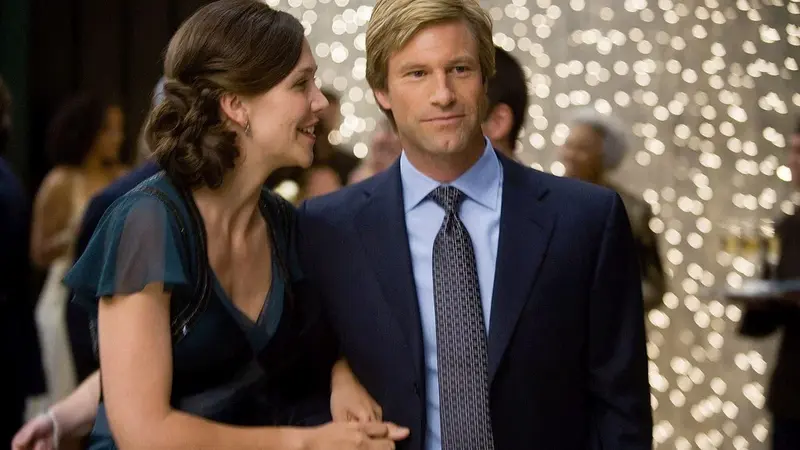
Gotham’s new hope is Harvey Dent, a district attorney who takes on organized crime through the legal system rather than behind a mask. Bruce is impressed by Dent because he represents something Batman cannot achieve alone: a future in which the law is strong enough to protect the city without needing a vigilante. If Dent succeeds, Bruce may finally be able to put the cowl aside.
There is also a personal complication. Rachel Dawes, Bruce’s longtime friend and former love interest, is now dating Dent, and Bruce struggles to hide his feelings. Meanwhile, Batman, Dent, and Lieutenant Gordon join forces to attack Gotham’s criminal underworld by targeting its financial operations. Their efforts put the mob under increasing pressure, but its accountant, Lau, anticipates the danger and flees to Hong Kong with the money, creating another challenge for Batman and the authorities.
Hong Kong and the Grab-and-Go
Batman tracks Lau to Hong Kong in an operation that takes the fight beyond Gotham. He enters a skyscraper, captures the mob’s accountant, and escapes with him using an aircraft extraction that brings Lau back to Gotham to face the authorities.
Once Lau is back in police custody, his information helps Gordon and Dent arrest many of Gotham’s leading mob figures in a coordinated sweep. On the surface, the operation looks like a major victory. But with their usual power structure under threat, the remaining criminals become increasingly desperate—and more willing to consider an ally as dangerous and unpredictable as the Joker.
The Joker Crashes the Mob Meeting
With their organization under pressure, Gotham’s surviving mob bosses gather to discuss what to do next. The Joker arrives without an invitation and offers to solve their Batman problem in exchange for half their money. When Gambol challenges him, the Joker responds with his infamous pencil trick, demonstrating just how casually he treats violence and intimidation.
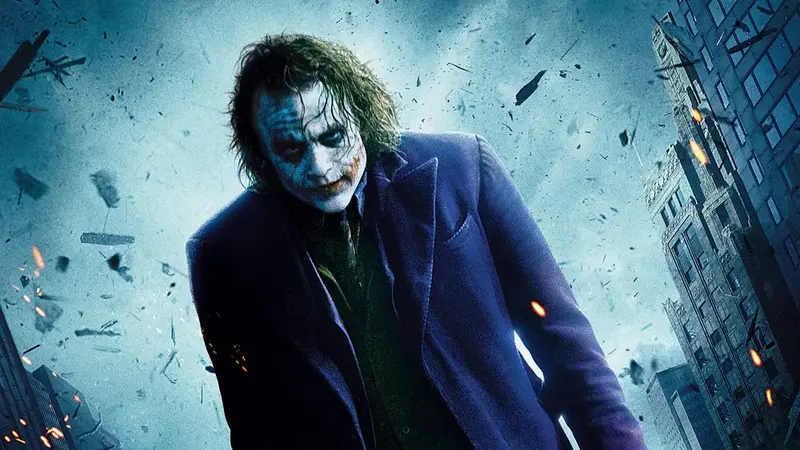
The stunt makes one thing clear: the Joker doesn’t behave like a conventional criminal who can be controlled through money or threats. Although the mob bosses recognize the danger he represents, their fear of Batman and the authorities leaves them tempted by his offer. They are considering a partnership with someone whose real motives they barely understand.
🎬 Want to watch The Dark Knight (2008)? 👉 Watch or buy it here on Amazon
A City on a Deadline
The Joker escalates his campaign of terror by announcing that more people will die unless Batman reveals his identity. His victims include Gambol, Judge Surrillo, and Police Commissioner Gillian B. Loeb. During a memorial service, Gordon appears to be shot while protecting the mayor, leaving Gotham believing that one of its most determined police officers has been killed. However, Gordon’s apparent death is a deliberate deception, part of a plan whose full purpose becomes clear later.
The Joker also sets fire to a huge pile of the mob’s money, revealing that wealth was never his true motivation. Unlike Gotham’s conventional criminals, he cannot be controlled through financial incentives or persuaded to follow the usual rules of organized crime. His willingness to destroy the very money he was supposedly trying to obtain makes him even more difficult to predict. As the death toll rises, Bruce begins to feel that revealing his identity might be the only way to stop the killings.
Dent Claims to Be Batman
Before Bruce can make that decision, Harvey Dent steps forward at a press conference and claims to be Batman. His announcement is a calculated bluff designed to protect Bruce’s identity while drawing the Joker into the open. The police place Dent in a convoy and move him through the city, hoping to lure the Joker into an attack.
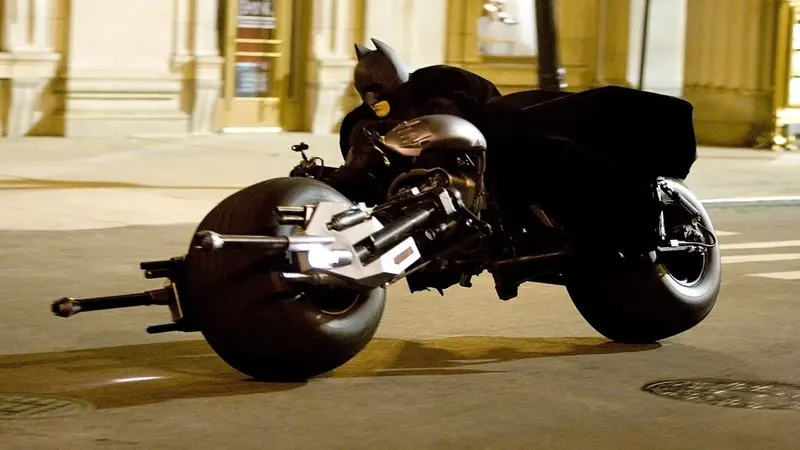
The plan works, triggering a dangerous pursuit through Gotham’s streets. Batman joins the chase, and his Batmobile transforms into the Batpod after being damaged. The pursuit reaches its most spectacular moment when the Joker’s enormous truck flips over, but Batman refuses to kill him. The Joker is eventually arrested, yet his reaction suggests that being captured is not the setback the authorities believe it to be.
The Interrogation Room
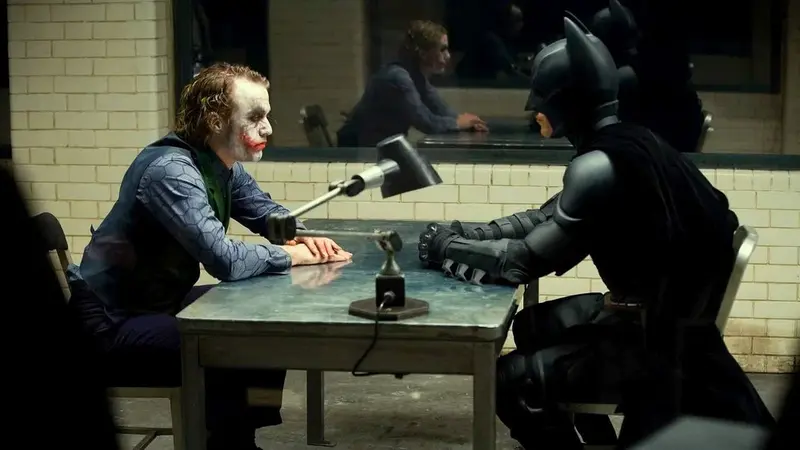
Batman finally gets the Joker alone in an interrogation room, hoping to learn where he is holding Harvey Dent and Rachel Dawes. The questioning quickly turns violent as Batman loses his temper and attacks him. But the Joker remains amused, treating Batman’s anger as evidence that even someone committed to justice can be pushed beyond his limits.
The Joker then reveals that he has kidnapped Dent and Rachel and gives Batman two addresses, claiming that each person is being held at a different location. Batman must choose where to go, believing there is only enough time to save one of them. He races toward the address he believes belongs to Rachel, unaware that the Joker has manipulated the information.
The Swapped Addresses
The Joker has deliberately switched the locations. Batman reaches the building where Dent is being held, while Gordon and the police head for Rachel. Both locations are rigged with explosives, leaving neither rescue team enough time to save the person they are trying to reach. Rachel dies in the explosion, while Dent survives but suffers severe burns to the left side of his face.
Rachel’s death changes the course of the film. Bruce loses the woman he hoped to build a future with, while Dent loses the person he loved and the belief that justice can protect the innocent. The Joker has turned a rescue attempt into a tragedy that will have consequences far beyond the immediate loss.
How Harvey Dent Became Two-Face
In hospital, Dent struggles with his injuries and refuses to accept what has happened. The Joker, disguised as a nurse, visits him and encourages him to see the world differently. He argues that the idea of fairness is an illusion and that people who believe they control their lives are often at the mercy of chance. By blaming the systems and people he once trusted, Dent becomes increasingly receptive to the Joker’s worldview.
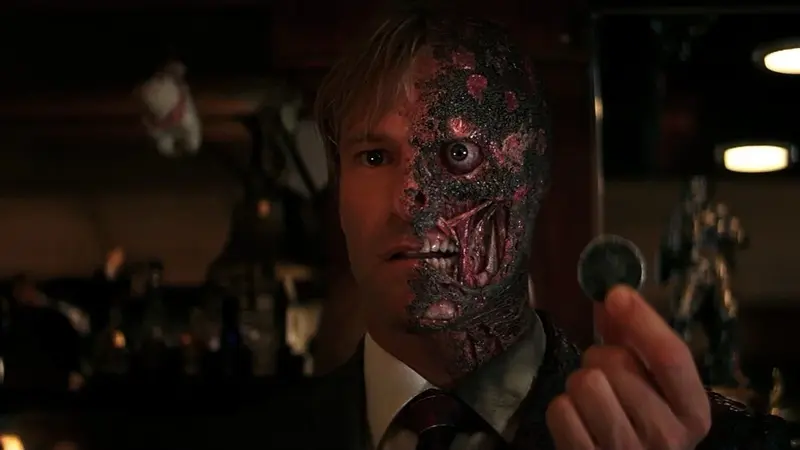
Dent’s lucky coin, once a symbol of his confidence and sense of control, has been damaged by the explosion. One side is now scarred, and he begins using the coin to decide people’s fates. Rather than relying on the law, he leaves life-and-death decisions to chance, turning his pain into a personal form of revenge. The Joker exploits Dent’s grief and disillusionment, then escapes the hospital as it is blown up.
Harvey’s coin originally had two identical sides, making its toss appear random while allowing him to control the outcome. After the explosion, one side is scarred, turning the coin into a genuine symbol of chance. By letting the toss decide people’s fates, Dent gives up responsibility for his choices and begins to justify revenge as fairness. His transformation is therefore more than physical: the man who once represented Gotham’s faith in justice now uses chance to decide who deserves to suffer.
Two-Face and the Coin Flip
As Two-Face, Dent begins hunting down the people he blames for Rachel’s death, including mob figures and corrupt police officers who helped the Joker. Each person faces the same ritual: Dent flips his coin to decide their fate. The coin gives every decision the appearance of fairness, but Dent is using chance to carry out his own revenge.
This is the Joker’s philosophy taking hold in Dent’s life. Once a symbol of Gotham’s faith in justice, Dent now treats morality as meaningless and leaves life-and-death decisions to a coin toss. His transformation shows how far the Joker has pushed him from the principles he once represented.
The Ferry Scene Explained
As panic spreads through Gotham, the city begins evacuating by ferry. The Joker has rigged two boats with explosives: one carries ordinary citizens, while the other carries prisoners and their guards. Each ferry is given a detonator for the other boat. The Joker tells the passengers that one group must destroy the other before midnight, or both ferries will explode.
Fear and suspicion spread as the passengers debate what to do. Some believe they should strike first to save themselves, but no one can bring themselves to press the button. On the prisoner’s ferry, a large inmate eventually takes the detonator from a guard and throws it out of the window. Despite the Joker’s attempt to turn the passengers against one another, neither boat attacks the other.
The scene becomes one of the film’s clearest challenges to the Joker’s worldview. He believes that people will abandon their principles when survival is at stake, but both groups refuse to make that choice. Their decision shows that fear does not necessarily erase compassion or moral responsibility.
🔥 Curious to see how this plays out? 👉 Watch the full movie here
Batman Finds the Joker
While the ferries face the Joker’s deadly ultimatum, Batman uses a surveillance system developed by Lucius Fox to locate him. The system turns mobile phones across Gotham into a vast sonar network, allowing Batman to map the city and track the Joker’s movements. Lucius objects to the scale of this invasion of privacy and agrees to help only because the threat is so urgent, insisting that the system be destroyed once the crisis is over.
The technology leads Batman to a building where the Joker is holding hostages. The Joker has dressed his men as hostages and the hostages as his men, making it difficult for the police to identify who needs rescuing. Batman reaches the building and fights his way through the confusion to confront the Joker.
During their confrontation, Batman gains the upper hand and leaves the Joker hanging upside down. Yet the Joker continues laughing, convinced that his plan has exposed the darkness within Gotham. His confidence sets up the film’s final moral conflict: whether his belief that everyone will eventually abandon their principles has actually been proven right.
Dent’s Last Stand in The Dark Knight ending explained
The Joker’s final move is to turn Harvey Dent into proof of his belief that anyone can be pushed into abandoning their principles. Batman realizes that the Joker has manipulated Dent’s grief and anger, but the damage has already been done. Dent has taken Gordon’s wife and children to the abandoned building where Rachel died, intending to make Gordon experience the same devastating loss.
Batman and Gordon arrive to confront Dent. Still relying on his coin toss to decide people’s fates, Dent puts Gordon and his young son in danger. When Dent prepares to decide the boy’s fate, Batman tackles him to save the child. Dent falls from the ledge and dies, leaving Batman and Gordon to face the consequences of what has happened.
The Lie That Saves Gotham
With Dent dead, Gordon and Batman face a difficult choice. Dent’s fall into violence threatens to destroy the public’s faith in the man who had become Gotham’s symbol of hope. If the truth about his actions becomes known, the city may lose faith in its justice system just when it needs that faith most.
Batman proposes taking responsibility for Dent’s murders, allowing Dent to remain a symbol of courage and justice in the public eye. Gordon reluctantly agrees, knowing that the truth will have to be concealed to protect the city from the consequences of Dent’s downfall. Batman becomes the person Gotham believes it must hunt, while Dent is remembered as a hero who died fighting crime.
As Gordon delivers his closing speech about the kind of hero Gotham needs, Batman rides away with police vehicles and dogs pursuing him. The Bat-Signal is destroyed, marking the end of the city’s open faith in Batman. Meanwhile, the Joker remains in custody, but his plan has left Gotham facing a painful moral compromise. Batman accepts the blame because he believes the city needs hope more than it needs the truth.
Who Is the Joker in The Dark Knight?
The Joker never gets a confirmed name, personal history, or clear criminal record. The police cannot find fingerprints, dental records, or an address that explains who he really is. The film deliberately leaves these questions unanswered. He tells different stories about his scars to different people: one involving an abusive father and another involving a wife he claims to have loved. Neither account is confirmed, so the question of how the Joker got his scars remains unanswered.
What the film reveals instead is how he operates. He plans robberies with precision, uses explosives and mobile phones to manipulate events, and understands how fear can turn people against one another. Money and conventional power mean little to him, as his decision to burn the mob’s fortune makes clear. His real objective is to challenge people’s beliefs about morality and prove that even those who consider themselves decent can be driven to abandon their principles.
Heath Ledger’s performance makes the character even harder to predict. His unusual voice, restless movements, and repeated licking of his lips create a disturbing sense that the Joker is never entirely settled or easy to read. Ledger completed his work on the film before his death in January 2008. In 2009, he was posthumously awarded the Academy Award for Best Supporting Actor for his performance.
How the Joker’s Experiments Reveal the Truth About Gotham
Here is what clicks on a rewatch. Nearly every Joker scheme is the same experiment with a different test subject, and that is his plan in a sentence. He pressures the mob, and the mob caves. He pressures Batman, and Batman loses his temper in the interrogation room. He pressures Dent, and Dent breaks. Then he pressures a whole city on two ferries, and for once the experiment fails because the passengers refuse to give in.
That pattern explains why the argument over whether the Joker wins never dies. By the numbers, he does considerable damage: Rachel is dead, Dent has become Two-Face, and Batman is a fugitive. But he never gets what he was really after: a Gotham that proves his point about human nature. The ferries are his clearest defeat. He causes terrible losses, but he cannot prove that everyone will abandon their principles when pushed far enough.
As for the real villain, the Joker is the loud one, but the quieter villain is fear. Gotham’s panic is what drives the mob toward him, sends the ferries into a deadly test, and makes Dent’s beliefs so easy to undermine.
Even Alfred bends the truth. He burns Rachel’s last letter, which reveals that she chose Harvey, so Bruce can keep believing she might have waited for him. It is the same kind of protective lie as Batman’s, told on a smaller scale. Both decisions leave us with an uncomfortable question: how much truth can people bear, and when does hiding it protect them—or prevent them from moving on?
The Dark Knight (2008) Ending Explained
The ending of The Dark Knight reveals that Batman’s greatest sacrifice is not physical but personal: he gives up his good name to protect Gotham’s faith in Harvey Dent. By the final act, the Joker has pushed the city toward chaos and corrupted Dent, the one man who seemed capable of fighting crime through the justice system. When Dent dies after threatening Gordon’s family, Batman and Gordon must decide what Gotham will learn about the man it once regarded as its white knight.
Batman takes the blame for Dent’s murders because he believes the truth could undo the progress Dent made against organized crime. If Gotham discovered that its celebrated district attorney had become a killer, public trust in the justice system could collapse, potentially threatening the criminal convictions built on Dent’s work. Batman asks Gordon to let him take responsibility for the crimes, allowing Dent to be remembered as a hero. Dent’s earlier observation that a hero either dies a hero or lives long enough to become the villain takes on a new meaning: Batman accepts the second fate so that Dent can retain the first.
The cover-up comes at a considerable cost. Dent is mourned as a martyr, while Batman becomes a fugitive blamed for the murders. The police pursue him, and the Bat-Signal is destroyed. Gotham loses the chance to recognize the person who protected it, while Batman accepts the public’s anger as part of the price of preserving Dent’s legacy. His decision protects the city’s immediate hope, but it also leaves Gotham believing a lie.
This is where the question of whether the Joker wins becomes more complicated. He succeeds in turning Dent against the principles he once defended, and he forces Batman to accept a public lie. Yet he fails to make Batman kill him or to prove that everyone will abandon their moral boundaries under pressure. The passengers on the two ferries also refuse to destroy one another. The Joker exposes genuine weaknesses in human nature, but he does not prove that goodness is merely an illusion.
Gordon’s closing speech to his son brings these ideas together. He explains why Gotham needs Batman to remain a protector in the shadows, even if the city must see him as a villain. The speech gives the film its title: Batman becomes the Dark Knight, a figure who accepts blame and rejection rather than allowing the city to lose all faith in its heroes. Unlike Dent, he refuses to abandon his principles, even when doing so costs him everything he has built.
Ultimately, Batman’s decision is neither a simple victory nor a clean solution. Gotham keeps its faith in Dent, but that faith depends on concealing the truth, and Batman must live with the consequences. He preserves his moral code while sacrificing his reputation, becoming the person the city needs even as it turns against him. The ending leaves us with a difficult question: can a lie protect a society’s hope without making that hope more fragile in the long run?
“A Hero Gotham Deserves”
Batman saves Gotham’s hope by sacrificing his own reputation. The Joker tries to prove that everyone will abandon their principles under pressure, but Batman refuses to kill him, and the passengers on the ferries refuse to turn against one another. Gotham may see Batman as a villain, yet his final choice preserves the principles Dent lost. Sometimes the hero who protects a city is the one it can no longer thank.
What Makes The Dark Knight Significant
Three themes define The Dark Knight. The first is order versus chaos: the Joker challenges Gotham’s belief that its laws and institutions can protect it. The second is the cost of becoming a symbol. Batman’s public image helps sustain hope, while Harvey Dent’s reputation becomes so important that the truth about his downfall is concealed. The third is the ferry dilemma: when ordinary people face extreme pressure, will they sacrifice others to save themselves or hold on to their principles?
Christopher Nolan also used IMAX cameras for selected sequences, bringing the format into a major Hollywood feature in an unprecedented way. The film combines large-scale action with questions about justice, fear, sacrifice, and public trust, giving its superhero conflict a deeper moral dimension.
👉 Watch The Dark Knight (2008) Now
Watch or buy The Dark Knight (2008) through these options:
Stream or buy — support MovieRevelations at no extra cost.
Disclosure: This post may contain affiliate links. We may earn a small commission if you purchase through these links.
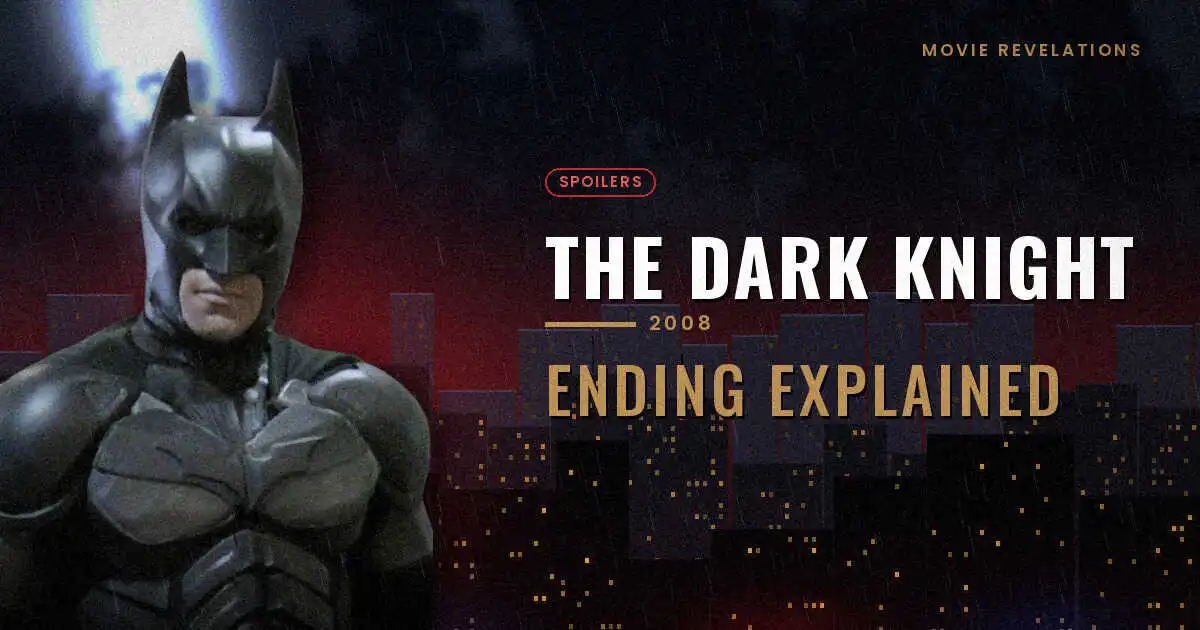
Featured image: Adapted from Batman (retouched) (cropped) by Hic et nunc, incorporating an original photograph by Andrew Guyton. Licensed under CC BY-SA 3.0. Modified for this article with an original background and title text. This adaptation is shared under CC BY-SA 3.0.
When Fear Reveals the Darkness Beneath the Surface
If The Dark Knight left you thinking about fear, human nature, and the choices people make under pressure, explore another unsettling thriller that examines prejudice and hidden motives. Read our breakdown of Get Out.
The Dark Knight (2008) FAQs
Why did Batman take the blame for Harvey Dent’s crimes?
Batman took the blame because Gotham needed to believe in Harvey Dent as its symbol of hope. After Dent became Two-Face and committed murders, revealing the truth would have destroyed the public’s faith in the man who had inspired the city. Batman accepted the blame to protect Dent’s legacy and preserve the hope it represented.
Does the Joker win at the end of The Dark Knight?
The Joker achieves a partial victory by corrupting Harvey Dent and forcing Batman to make a painful sacrifice. However, he fails to make Batman kill him or persuade the passengers on the two ferries to destroy each other. His plan exposes human weakness but does not prove that everyone will abandon their morality under pressure.
What happens to the Joker at the end of The Dark Knight?
Batman captures the Joker after discovering his plan to force the two ferry groups to choose whether to destroy each other. The Joker remains alive and is taken into police custody. Although he has caused enormous damage, he has not succeeded in making Batman kill him or turning the ferry passengers against each other.
What does the ending of The Dark Knight mean?
The ending explores the cost of protecting hope and the difference between being a hero and being a symbol. Batman takes responsibility for Harvey Dent’s crimes so Gotham can continue believing in Dent’s fight against corruption. By allowing himself to become a hunted figure, Batman sacrifices his reputation to protect the city’s fragile faith in justice.
Why did Harvey Dent become Two-Face?
Harvey Dent becomes Two-Face after the Joker arranges for Dent and Rachel Dawes to be held at separate locations rigged with explosives. Batman saves Dent, but Rachel dies in the explosion, and Dent suffers severe burns to one side of his face. Grief, rage, and the Joker’s manipulation push Dent toward revenge, and he begins using his damaged coin to decide the fates of those he blames.
Is The Dark Knight based on a true story?
No. The Dark Knight is a fictional superhero crime film based on DC Comics characters, including Batman, the Joker, and Harvey Dent. Its themes of corruption, fear, justice, and moral compromise reflect real-world concerns, but the story and its events are fictional.
Why does the Joker keep licking his lips in The Dark Knight?
Heath Ledger developed the lip-licking mannerism as part of his portrayal of the Joker. It became one of the character’s distinctive physical traits and helped create his unsettling, unpredictable presence. The film does not provide a specific in-story explanation for the habit.
Did Heath Ledger finish filming The Dark Knight before he died?
Yes. Heath Ledger completed his filming for The Dark Knight before his death in January 2008. The film was released later that year, and Ledger posthumously won the Academy Award for Best Supporting Actor for his performance as the Joker.